


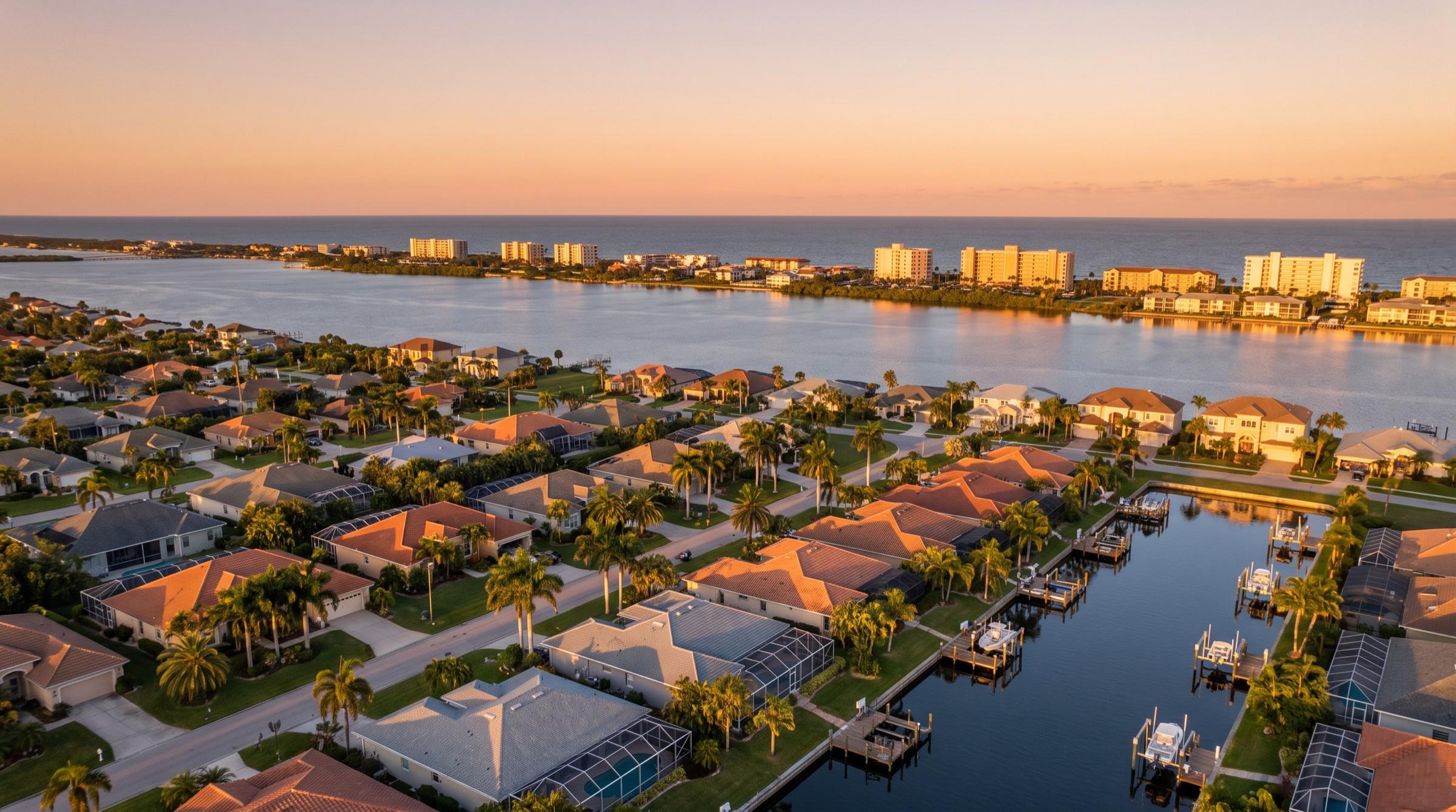
Florida trades one big cost for two others: no state income tax, ever — against homeowners insurance at roughly double the national average and some of the highest association dues in the country. Here is what property tax, insurance, HOA fees, and utilities actually run on the Space Coast in 2026, and the three real monthly budgets they add up to.
The short answer
Florida trades one big cost for two others. You stop paying state income tax — permanently, by constitutional prohibition — and you start paying more for insurance, and more in association dues than almost anywhere else in the country. Property tax lands roughly in the middle of the national pack.
For a household buying a $400,000 home on the Space Coast, the recurring cost of living here breaks down to roughly:
| Line item | Monthly | Annual |
|---|---|---|
| Property tax (Brevard, ≈0.86% effective) | ≈ $287 | ≈ $3,440 |
| Homeowners insurance (mainland, tier 2) | ≈ $208 | ≈ $2,500 |
| Homeowners insurance (barrier island, tier 5) | ≈ $450 | ≈ $5,400 |
| Flood insurance (if carried) | $40–$250 | $480–$3,000 |
| Electric (FPL, 1,000 kWh) | ≈ $137 | ≈ $1,640 |
| Water, sewer, trash | $90–$150 | $1,080–$1,800 |
| HOA / condo dues (if any) | $90–$860 | $1,080–$10,300 |
| State income tax | $0 | $0 |
Two of those lines swing by thousands of dollars depending on which side of the Banana River you buy on. That is the whole story of Florida cost of living, and it is why the national "cost of living in Florida" calculators are close to useless — they average a Panhandle ranch and an oceanfront condo and hand you a number that describes neither.
Here is what each line actually is, and where the Space Coast lands.
The trade: no income tax, higher carrying costs
Florida is one of a handful of states with no personal income tax, and unlike most of them, the ban is written into the state constitution rather than left to the legislature. There is no state income tax, no state estate tax, and no state inheritance tax.
For a household with $100,000 of taxable income, that is real money — call it $3,000 to $6,000 a year that would have gone to Albany, Trenton, or Atlanta. For a retiree drawing on a pension or an IRA, it is larger still, because Florida does not tax retirement income either.
The honest counterweight: the state gets it back through property insurance and association dues. Those are not taxes, so they never show up in a state-tax comparison chart, but they come out of the same paycheck. A Cocoa Beach condo owner paying $858 a month in dues and $5,400 a year in insurance has handed over more than the income tax they escaped. A Palm Bay homeowner in a no-HOA neighborhood with a newer roof has not, by a wide margin.
Where you land in that spread is a function of five specific decisions, not of "Florida."
Property tax: lower than you think, with a catch
Brevard County's effective property tax rate runs about 0.86% of market value — near the national median and well under New York, New Jersey, Illinois, or Texas. On a $400,000 home, that is roughly $3,440 a year before exemptions.
Three mechanics matter more than the rate:
1. The homestead exemption. File on your primary residence by March 1 and Florida removes up to $51,411 of assessed value for 2026 — the original $25,000 (which applies to all levies including schools) plus an inflation-adjusted $26,411 that applies to everything except school taxes. On a typical Brevard bill that is worth roughly $700 to $900 a year. Our homestead exemption guide walks the filing.
2. Save Our Homes. This is the part that compounds. Once homesteaded, your assessed value cannot rise more than 3% a year (or the rate of inflation, whichever is lower) regardless of what the market does. Ten years into a rising market, the gap between what your neighbor's newly-purchased home is assessed at and what yours is assessed at can be six figures. It is the single largest financial reason long-time Florida owners stay put.
3. Your bill is not the seller's bill. A new owner's assessment resets to the sale price, and the seller's homestead cap resets with it. The tax line on the listing sheet describes the seller's situation, not yours. Budget above it — often well above it. This is the most common budgeting error we see out-of-state buyers make, and it is entirely avoidable: our mortgage calculator runs the reset number.
One thing to watch on November 3, 2026. Florida voters will decide Amendment 3 (CS/HJR 1F, the "Save Our Homes from Excessive Property Taxes" measure), which would raise the homestead exemption to $150,000 in 2027 and $250,000 in 2028, indexed for inflation after that, and tighten the assessment cap on non-homestead property — rentals, second homes, commercial — from 10% to 5% a year. It applies to non-school levies only; school district taxes stay. It needs 60% to pass, and Florida's Revenue Estimating Conference puts the recurring cost to local government at roughly $12 billion a year.
There is a deadline buried in it that matters enormously if you are moving here: anyone who establishes Florida residency on or after January 1, 2027 keeps only the existing ~$50,000 exemption for five years before the expanded one becomes available. Nobody should buy on the assumption it passes — but if you were already planning a 2027 move, the calendar is suddenly part of the decision.
Insurance: the line that actually breaks budgets
This is where Florida earns its reputation, and where the spread is widest. Our full breakdown lives in how much homeowners insurance costs in Florida and the coastal insurance guide; the short version for budgeting:
| Exposure tier | Where | Rough annual premium |
|---|---|---|
| 1 — inland | Orlando, Sanford, Lake County, Kissimmee | ≈ $1,900 |
| 2 — mainland Brevard | Palm Bay, Rockledge, Viera, Titusville, Suntree | ≈ $2,500 |
| 3 — river-adjacent | Melbourne, Cocoa Village | ≈ $3,300 |
| 4 — island, not oceanfront | Merritt Island | ≈ $4,300 |
| 5 — barrier island | Cocoa Beach, Cape Canaveral, Satellite Beach, Indialantic, South Beaches | ≈ $5,400 |
Three things that trip up newcomers:
- Flood is a separate policy. Always. Standard homeowners coverage excludes rising water, storm surge, and lagoon overflow. Roughly a quarter of national flood claims come from properties outside mapped high-risk zones, which is why the cheap optional policy is usually worth buying. See the flood zone guide and our VE zone breakdown.
- The roof sets the price. Age, shape, and attachment method matter more than anything else on the quote. A 20-year-old shingle roof can be uninsurable at any sane price.
- Rates are finally moving down. After the 2022–2023 tort reforms, 18 private carriers have entered or re-entered Florida, and 2026 filings from Citizens, State Farm, Florida Peninsula, and others are decreases. From a very high base — but "Florida insurance only goes up" stopped being true.
HOA and condo dues: the line nobody budgets for
Here is data you will not find on a national cost-of-living site. Across 5,094 active residential listings in Brevard County in our MLS feed, 55% carry recurring association dues, at a median of $225 a month. But the town-by-town spread is enormous — and dues are quoted on six different cadences in the MLS, so everything below is normalized to a monthly equivalent:
| Town | Share of listings with dues | Median monthly dues |
|---|---|---|
| Cocoa Beach | 82% | $858 |
| Indialantic | 66% | $653 |
| Cape Canaveral | 83% | $625 |
| Satellite Beach | 71% | $620 |
| Indian Harbour Beach | 71% | $500 |
| Melbourne Beach | 65% | $385 |
| Cocoa | 36% | $250 |
| Titusville | 58% | $200 |
| Melbourne | 76% | $150 |
| Merritt Island | 43% | $118 |
| Rockledge | 72% | $104 |
| Palm Bay | 31% | $91 |
Read that table next to the insurance table and the pattern is obvious: beachside dues are mostly insurance. The median Cocoa Beach listing carries roughly nine times the monthly dues of the median Palm Bay listing — a gap no difference in landscaping or amenities explains. A Cocoa Beach association buys wind and flood coverage for an oceanfront building and spreads it across the units. You are not avoiding the tier-5 premium by buying a condo; you are prepaying it through dues, along with the roof, the elevators, the seawall, and the reserves.
Two forces are pushing those numbers up right now. Florida HOA fees have climbed roughly 68% over five years, and post-Surfside law now forbids condo associations from waiving reserves on eight structural components. Buildings that kept dues artificially low for two decades are repricing all at once — which is exactly why a low fee on a 1970s oceanfront building is a warning sign, not a bargain. We cover that in detail in Florida condo assessments and milestone inspections.
Utilities and the everyday stuff
- Electric. Most of Brevard is Florida Power & Light. FPL's typical 1,000-kWh residential bill is $136.64 a month for 2026, up about 2% under the four-year rate settlement approved in November 2025. Real Florida summers run higher — 1,200 to 1,500 kWh in July and August is normal for a 2,000-square-foot house, so budget $170–$210 in the hot months and less in winter. Pool pumps add $30–$60.
- Water, sewer, and trash. Municipal utilities, so it varies by city. Plan on $90 to $150 a month combined for a family home; irrigation-heavy yards push higher.
- Sales tax. 6% state plus a 1% Brevard discretionary surtax = 7%, applied to only the first $5,000 of any single item. Groceries and prescriptions are exempt. (Both half-cent county surtaxes are scheduled to sunset December 30, 2026 unless voters renew them.)
- Overall. The Palm Bay–Melbourne–Titusville metro scores about 95 on the cost-of-living index against a national baseline of 100 — a few percent cheaper than the U.S. average overall, with housing and taxes cheap and insurance expensive.
One-time costs of actually moving here
These are not recurring, but they surprise people in month one:
- $225 initial vehicle registration fee per vehicle for first-time Florida registrants, plus title ($75.25–$85.25) and plates (about $28).
- Florida driver's license within 30 days of establishing residency; vehicle registration within 10 days of starting work or enrolling a child in school.
- Closing costs. Doc stamps, intangible tax, title, and prepaids — see the closing costs breakdown.
- Homestead filing by March 1 of the year after you take title. Missing it costs you a full year of exemption and a year of Save Our Homes protection.
So what does it actually cost?
Three real Space Coast profiles, all-in monthly carrying cost excluding mortgage principal and interest:
Palm Bay, $350,000 single-family, no HOA, newer roof Tax $251 + insurance $208 + electric $150 + water $110 = ≈ $719/month
Rockledge, $400,000 in a master-planned community Tax $287 + insurance $208 + dues $104 + electric $150 + water $110 = ≈ $859/month
Cocoa Beach, $450,000 oceanfront condo Tax $323 + HO-6 unit policy $110 + dues $858 + electric $110 = ≈ $1,401/month
All three pay $0 in state income tax. The oceanfront condo costs roughly twice what the inland house costs to carry, and almost all of that difference is two lines: insurance and the dues that are mostly insurance. It is also still, by a wide margin, the cheapest oceanfront in Florida. That is the actual trade, stated plainly.
If you want the inland-versus-beachside math on your own numbers, compare towns side by side or check the current Space Coast market data.
Frequently asked questions about the cost of living in Florida
Is Florida actually cheaper to live in than other states?
It depends entirely on which costs dominate your budget. Florida has no state income tax, no estate tax, no inheritance tax, and property tax rates near the national median — Brevard County's effective rate is about 0.86%. Against that, homeowners insurance runs roughly double the national average and association dues are among the highest in the country. High earners and retirees drawing on retirement income usually come out well ahead. Households with modest income and a high-exposure coastal property often do not. The Palm Bay–Melbourne–Titusville metro scores about 95 on the cost-of-living index versus a national baseline of 100.
How much is property tax in Florida?
Rates are set county by county. Brevard County's effective rate averages about 0.86% of market value — roughly $3,440 a year on a $400,000 home before exemptions. A homestead exemption removes up to $51,411 of assessed value in 2026 (typically $700–$900 off the bill) and caps annual assessed-value increases at 3% under Save Our Homes. Your bill resets to your purchase price when you buy, so never budget from the seller's tax figure.
Does Florida really have no state income tax?
Yes, and it is constitutionally prohibited rather than merely absent — the legislature cannot enact one without a constitutional amendment. Florida also has no state estate tax and no inheritance tax, and it does not tax pensions, Social Security, or IRA withdrawals. You still owe federal income tax.
Why are HOA and condo fees so high in Florida?
Two reasons. First, coastal associations buy the building's wind and flood insurance and spread it across the units, so beachside dues are largely a prepaid insurance premium. Second, post-Surfside law now bars condo associations from waiving reserve funding on eight structural components, so buildings that underfunded reserves for decades are catching up all at once. In our MLS data, normalized to a monthly equivalent, Cocoa Beach listings carry median dues of $858 a month and Cape Canaveral $625, against $91 in Palm Bay and $104 in Rockledge.
How much are utilities in Florida per month?
Most of Brevard County is served by Florida Power & Light, whose typical 1,000-kWh residential bill is $136.64 a month for 2026. Real-world summer usage runs higher — budget $170 to $210 in July and August for a 2,000-square-foot home, less in winter, plus $30 to $60 if you have a pool pump. Water, sewer, and trash together typically run $90 to $150 a month depending on the city and how much you irrigate.
What is the sales tax in Brevard County, Florida?
7% — the 6% state rate plus a 1% county discretionary surtax made up of two half-cent levies for infrastructure and school capital outlay. The county portion applies only to the first $5,000 of any single item, which matters on vehicles and boats. Groceries and prescription drugs are exempt from Florida sales tax. Both half-cent surtaxes are scheduled to expire December 30, 2026 unless renewed by voters.
Will Florida eliminate property taxes in 2026?
Not eliminate — reduce. Florida voters decide Amendment 3 (CS/HJR 1F) on November 3, 2026, which would raise the homestead exemption to $150,000 in 2027 and $250,000 in 2028 with inflation indexing thereafter, and tighten the non-homestead assessment cap from 10% to 5% annually. It applies only to non-school levies; school district taxes are unaffected. It requires 60% approval, and Florida's Revenue Estimating Conference estimates a recurring cost of about $12 billion a year to local governments. Anyone who establishes Florida residency on or after January 1, 2027 would keep only the existing ~$50,000 exemption for five years before qualifying for the expanded amount.
What does it cost to move to Florida from out of state?
Beyond moving costs: a $225 initial vehicle registration fee per vehicle, a title fee of $75.25 to $85.25, and about $28 for plates. You have 30 days to get a Florida driver's license after establishing residency and 10 days to register a vehicle after starting work or enrolling a child in school. Then file for homestead exemption by March 1 of the following year — missing that deadline costs a full year of both the exemption and Save Our Homes protection.
Run the numbers on a real address
Averages are a starting point. The number that matters is the one attached to a specific house, with a specific roof age, a specific flood determination, and a specific association budget — and that number can differ by $1,000 a month across two homes at the same price.
That is the work we do before you write an offer: pull the tax reset, quote wind and flood on the actual address, read the association budget and reserve study, and put the real carrying cost into your payment math.
Start with the insurance guide and the homestead exemption guide, model it in the mortgage calculator, and compare the trade-off directly: Palm Bay inland against Cocoa Beach on the sand. Browsing? See current Space Coast listings.
When you have an address in mind, get in touch and we will build the real budget for it.
Figures are 2026 estimates and industry-reported ranges, not quotes. Property tax, insurance, and association dues vary by property; your actual costs depend on the specific address, exemptions, carrier, and association. Association-dues and listing statistics are 7 Waves calculations from active Space Coast MLS residential listings as of July 2026, normalized to a monthly equivalent from the frequency each listing reports (monthly, quarterly, semi-annual, or annual) and excluding voluntary and one-time fees; they describe listed inventory, not all housing stock. Tax figures reflect 2026 law and pending 2026 ballot measures, which may change. Nothing here is tax, legal, or insurance advice — consult a licensed professional. Information deemed reliable but not guaranteed.
Want to talk this through?
Ask a local agent — no obligation, and usually an answer the same day.