


A VE flood zone is FEMA's coastal high-hazard designation — the 1% flood plus wave action. Here is what it changes for a Space Coast buyer, why your zone no longer sets your premium, and why the most flood-exposed towns on this coast sell for 40% more, not less.
What is a VE flood zone?
A VE flood zone is FEMA's designation for a coastal high-hazard area — land facing both the 1%-annual-chance flood and damaging wave action of three feet or more. It is the highest-risk zone FEMA maps. If you buy in a VE zone with a federally backed mortgage, flood insurance is mandatory, and new construction must be elevated on pilings or columns with the space below left open.
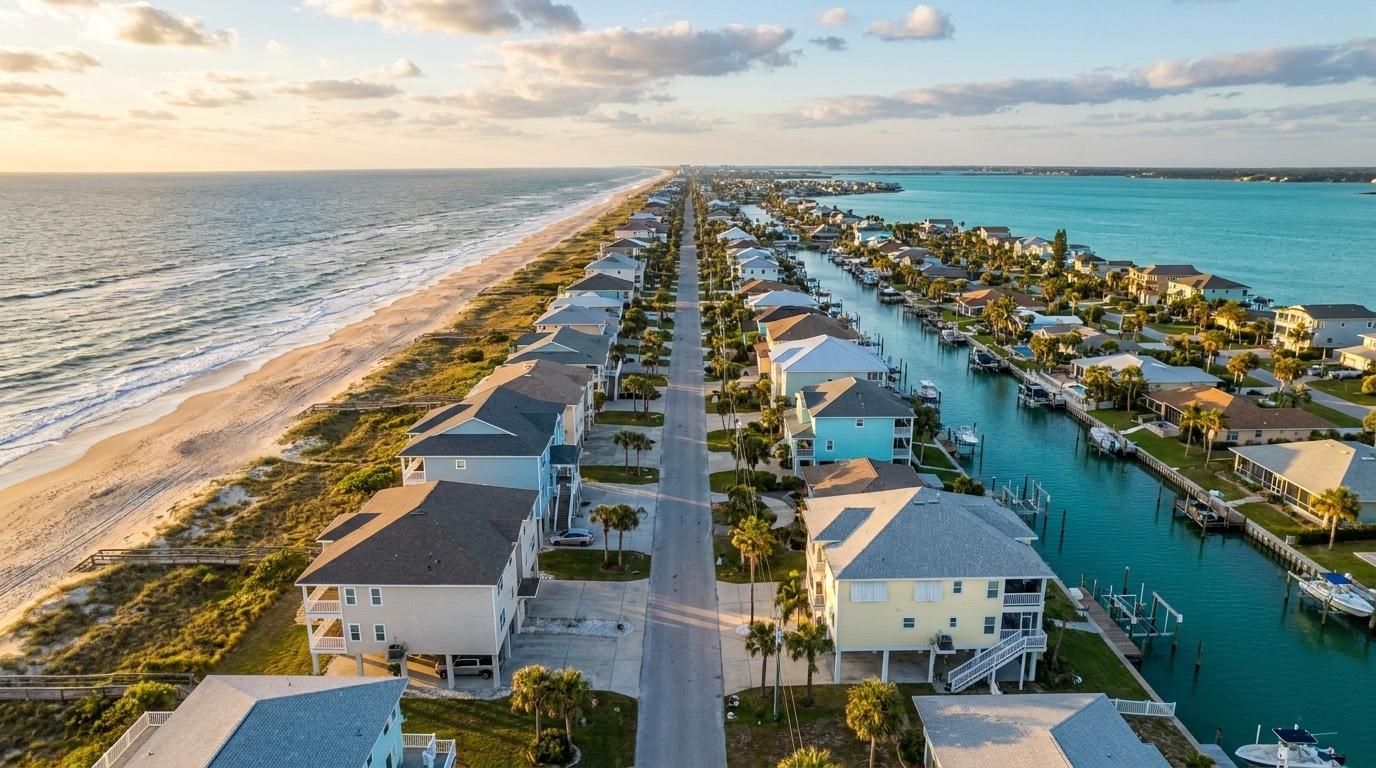
On Florida's Space Coast, VE zones run along the Atlantic-facing edge of the barrier island — the oceanfront strips of Cocoa Beach, Cape Canaveral, Satellite Beach, Indialantic, and Melbourne Beach. The "V" stands for velocity: the wave energy that separates a VE zone from an ordinary high-risk AE zone a few hundred feet inland.
Here is what almost nobody tells you, and what the rest of this guide is about: on this coast, being in a flood zone correlates with paying more for a house, not less. The beachside towns with the highest flood exposure carry a median sale price roughly 40% above the mainland towns with the least. That is not a market failing to price risk. It is the market pricing the thing that creates the risk — proximity to water — as the amenity people move here for.
VE vs AE vs X: what the letters actually change
| Zone | What it means | Flood insurance with a mortgage | Typical Space Coast location |
|---|---|---|---|
| VE | Coastal high-hazard: the 1% flood plus waves of 3+ feet | Required | Oceanfront strip of the barrier island |
| AE / A / AH | High risk: 1% annual chance flood, no significant wave action | Required | Riverfront, canal, and lagoon edges |
| X | Minimal to moderate risk, outside the mapped floodplain | Optional | Most inland Brevard County |
Two practical notes that matter more than the letters:
- "X" does not mean "won't flood." Roughly a quarter of all NFIP flood claims come from properties outside high-risk zones. X means insurance is optional and cheap — which is precisely the argument for buying it.
- Zone lines are drawn by parcel, not by town. A street in Cocoa Beach can have VE on the ocean side and AE across the road. Never assume a zone from a neighborhood; pull the determination for the specific address.
The part most people get wrong: your zone no longer sets your premium
This is the single biggest misconception we correct with buyers, and it changed in 2021.
Under FEMA's Risk Rating 2.0, flood zones are no longer used to calculate what you pay. The old system priced off the zone and a rating table. The new one prices each property individually on its own characteristics:
- Distance to a flooding source
- First-floor height relative to the base flood elevation
- Foundation type
- Replacement cost of the structure
- The types of flooding the property is actually exposed to
Your zone still determines whether insurance is required. It no longer determines what it costs. That means two houses in the same VE zone, on the same street, can be quoted thousands of dollars apart based on how high the finished floor sits and how the foundation is built.
It also means the elevated-on-pilings construction that VE zones require is not just a building code burden — it is the thing that pulls the premium back down. A properly elevated VE home can rate better than a slab-on-grade house in an AE zone.
Ranges, not quotes: industry trackers put Florida's average NFIP premium near $1,363 a year, with coastal VE-zone properties commonly quoted anywhere from roughly $5,000 to $15,000+ depending on elevation and construction. Those spreads are so wide that the average is close to useless for decision-making. The only number that matters is a quote on the actual address, pulled during your inspection period.
Which Space Coast towns are actually in flood zones?
This is the table we could not find anywhere else, so we built it. Flood-zone share is our own approximate estimate of the share of parcels within a FEMA flood zone; median price is residential closed sales from the Space Coast MLS for the twelve months ending July 30, 2026.
| Town | Approx. parcels in a FEMA flood zone | Median closed price |
|---|---|---|
| Melbourne Beach (South Beaches) | 75% | $657,000 |
| Cocoa Beach | 70% | $485,000 |
| Cape Canaveral | 65% | $302,500 |
| Indialantic | 60% | $632,500 |
| Merritt Island | 60% | $475,000 |
| Satellite Beach | 55% | $529,000 |
| Indian Harbour Beach | 55% | $465,000 |
| Grant-Valkaria | 30% | $570,000 |
| Malabar | 30% | $560,000 |
| Cocoa & Cocoa Village | 25% | $315,000 |
| Melbourne | 20% | $400,000 |
| Mims | 20% | $370,500 |
| Titusville | 15% | $290,000 |
| Rockledge & Viera | 10% | $379,000 |
| Palm Bay | 10% | $321,990 |
Read the top of that table against the bottom. The seven beachside towns where 55–75% of parcels sit in a flood zone carry a combined median of $485,000. The six mainland towns at 10–25% carry a combined median of $346,250.
Flood-zone exposure on the Space Coast comes with a 40% price premium, not a discount.
Cape Canaveral is the one apparent exception — 65% flood exposure at a $302,500 median — and the reason is housing mix, not risk pricing. Roughly seven of eight sales there are condos, where a master policy often covers the building's flood insurance and the unit owner never sees a separate premium line. It is the cheapest way onto the barrier island precisely because of that structure.
So do flood-zone homes actually sell?
They are the best-performing segment on this coast. Waterfront — the most exposed property type there is — commands a premium in every market we track:
| Market | Median, all residential | Median, waterfront |
|---|---|---|
| Indian Harbour Beach | $465,000 | $875,000 |
| Melbourne Beach | $657,000 | $815,000 |
| Satellite Beach | $529,000 | $705,000 |
| Merritt Island | $475,000 | $607,000 |
| Melbourne | $400,000 | $535,000 |
None of this means flood risk is fake. It means the risk is known, insurable, and already in the price — and that a buyer who understands the mechanics has a real advantage over one who panics at the letters. The buyers who lose money here are not the ones who bought in a VE zone. They are the ones who bought without quoting the premium first.
What a VE zone actually changes for you
Insurance is mandatory, not optional. With a federally backed mortgage in a VE or AE zone, you will carry flood coverage for the life of the loan. Budget it as a payment line from day one, alongside wind coverage — which on this coast is often the larger of the two.
Construction standards are strict. New and substantially improved VE-zone homes must be elevated on pilings or columns with the area below free of obstruction. That is why the beachfront streets look the way they do, with parking and storage underneath the living space. It is also why those homes often insure better than they look on paper.
The elevation certificate is the most valuable document in the file. It records where the finished floor sits relative to the base flood elevation. Under Risk Rating 2.0 that height is a primary pricing input. If a seller has one, get it. If the house sits meaningfully above the BFE, it can also support a Letter of Map Amendment (LOMA) — a formal FEMA determination that can remove the mandatory purchase requirement entirely.
The seller's NFIP policy may be assumable. NFIP policies transfer at closing. If the seller holds an older policy still on the Risk Rating 2.0 glide path, taking it over can lock in a rate a brand-new policy cannot match. Ask early — this is routinely left on the table.
Mind the 30-day rule. A new NFIP policy normally carries a 30-day waiting period, waived when it is tied to a loan closing. Cash buyers do not get that waiver. Start early or you will own an uninsured beach house for a month.
Watch the binding suspensions. When a named storm enters the basin, insurers stop writing new policies. For contracts written August through October, build buffer days into the timeline.
What to check before you write an offer
- Pull the flood determination for the exact address — FEMA's Map Service Center, by address, not by neighborhood.
- Get a real flood quote during the inspection period. Not an estimate. Not the seller's old premium. A quote in your name.
- Request the elevation certificate and the finished-floor height relative to BFE.
- Ask whether the seller's NFIP policy is assumable and what it currently costs.
- Read the Florida flood disclosure. Since October 2024, sellers must disclose flood history and past claims or federal assistance on a statutory form.
- Quote wind separately. On the barrier island, wind mitigation features — roof age, shape, attachments, opening protection — often move the total premium more than the flood zone does.
- If it is a condo, read the master policy to see whether building flood coverage is included and what the unit owner is still responsible for.
Frequently asked questions
What does VE flood zone mean?
VE is FEMA's coastal high-hazard flood zone — areas exposed to the 1%-annual-chance flood plus wave action of three feet or more. It is the highest-risk designation FEMA maps. Flood insurance is required with a federally backed mortgage, and new construction must be elevated on pilings or columns with the space below left open.
What is the difference between a VE and an AE flood zone?
Both are high-risk Special Flood Hazard Areas where flood insurance is mandatory with a federally backed mortgage. The difference is wave action: VE zones face damaging waves of three feet or more, AE zones do not. On the Space Coast, VE typically runs along the Atlantic-facing oceanfront, while AE covers river, canal, and lagoon edges. VE carries stricter elevated-construction requirements.
Is flood insurance more expensive in a VE zone?
Usually, but not because of the zone itself. Since FEMA's Risk Rating 2.0 took effect in 2021, premiums are calculated from property-specific characteristics — first-floor height, foundation type, distance to water, and replacement cost — rather than from the flood zone. Two homes in the same VE zone can be quoted thousands of dollars apart. Get a quote on the specific address.
Can you get a mortgage on a VE zone home?
Yes. VE-zone homes are financed routinely on the Space Coast. The lender will require flood insurance for the life of the loan, and the premium becomes part of your qualifying payment — which is why quoting it early matters, since it affects how much home you qualify for.
Are flood zone homes on the Space Coast worth less?
The opposite, on this coast. The seven beachside towns where 55–75% of parcels sit in a flood zone carry a combined median sale price of $485,000, against $346,250 for the six mainland towns at 10–25% exposure — roughly a 40% premium. Waterfront property outsells the overall market in every Space Coast city we track.
How do I find out what flood zone a property is in?
Use FEMA's Map Service Center for the official determination by address, and confirm with your insurance agent before your inspection period ends. Do not rely on a neighborhood-level assumption — zone lines are drawn parcel by parcel, and the designation can change across a single street.
Get the real number on a real address
Flood zone is a price signal, not a verdict — but only if you actually price it. We pull the determination, request the elevation certificate, quote flood and wind side by side, and check whether the seller's policy can come with the house. Before the offer, not after.
Read our full flood zones buying and selling guide for the process end to end, compare the insurance picture across coverage types, or see the flood layer town by town on our service area map. Browsing? Start with current Space Coast listings, or read why Cape Canaveral and Cocoa Beach still pencil out despite the exposure.
When you have an address in mind, get in touch and we will run the numbers on it.
Flood-zone share figures are 7 Waves estimates of the approximate share of parcels within a FEMA flood zone and are not a substitute for an official FEMA determination. Median price figures reflect residential closed sales from the Space Coast MLS for the twelve months ending July 30, 2026. Premium ranges are industry-reported figures, not quotes. Nothing here is insurance, legal, or tax advice. Information deemed reliable but not guaranteed.
Want to talk this through?
Ask a local agent — no obligation, and usually an answer the same day.