


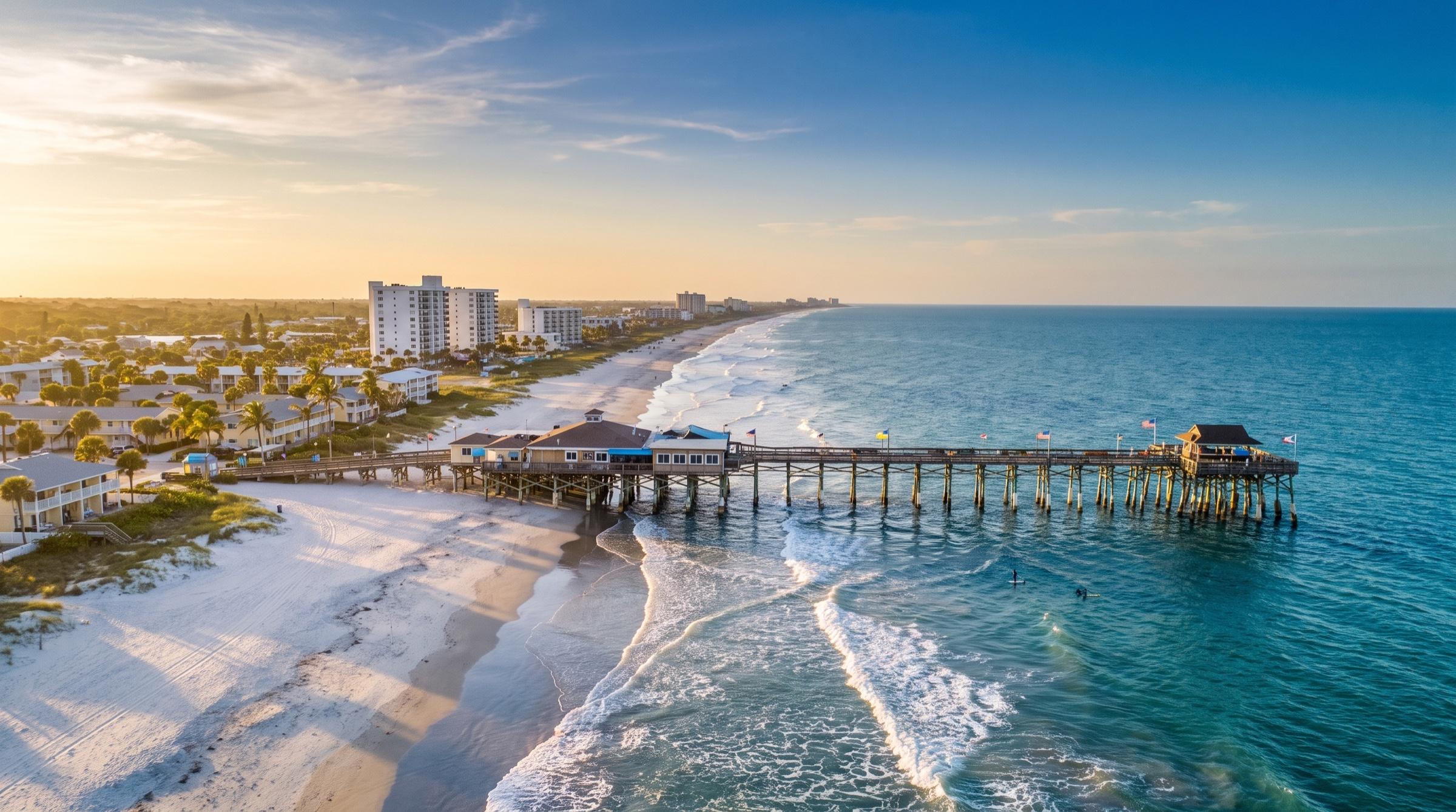
Cocoa Beach pairs six miles of public Atlantic shoreline, no state income tax, and rocket launches off the sand with a median sale price of $485,000 — coastal Florida living at a price Naples, Key West, and Miami Beach stopped offering years ago.
Is Cocoa Beach really the best place to live in Florida?
For the right person, yes — and the case rests on numbers rather than brochure copy. Cocoa Beach is a barrier-island city of roughly 11,000 people in Brevard County, about an hour east of Orlando. It has six miles of public Atlantic shoreline, a pier that has stood since 1962, the largest surf shop on Earth, and a front-row seat for every rocket that leaves Cape Canaveral. What makes it genuinely unusual is that it delivers all of that at a price most of coastal Florida abandoned a decade ago.
Over the twelve months ending July 30, 2026, 419 residential properties sold in Cocoa Beach at a median price of $485,000 — that figure comes from our own live Space Coast MLS feed, not a national estimate. Set it against Redfin's mid-2026 numbers for Florida's better-known coastal towns and the argument makes itself.
| Florida coastal market | Median price, mid-2026 |
|---|---|
| Naples | $1,300,000 (sale) |
| Key West | $1,100,000 (list) |
| Miami Beach | $590,000 (sale) |
| Cocoa Beach | $485,000 (sale) |
| Sarasota | $475,000 (single-family sale) |
| Florida, statewide | $395,595 (sale) |
Cocoa Beach costs a third of Naples and less than Miami Beach, while offering something neither can: a walkable, low-rise, genuinely residential beach town where the pier, the grocery store, and the tiki bar are all a bike ride apart.
What does it actually cost to live in Cocoa Beach?
Expect roughly $485,000 for a typical home, but the median hides a split that matters enormously to buyers: condos and houses are effectively two different markets here.
| Cocoa Beach residential market | Figure |
|---|---|
| Median closed price, all residential | $485,000 |
| Homes sold, trailing 12 months | 419 |
| Median closed price — with an association fee (mostly condos) | $380,000 |
| Median closed price — no association fee (mostly houses) | $835,000 |
| Median closed price — waterfront | $502,500 |
| Median days on market | 78 |
| Active listings | 202 |
| Median list price, active | $517,500 |
| Active price range | $159,900 – $3,450,000 |
| Median year built | 1979 |
That condo-versus-house gap — $380,000 against $835,000 — is the single most useful fact for anyone planning a Cocoa Beach budget. An oceanfront or riverfront condo is a genuinely attainable way onto the island. A canal-front house in Cocoa Isles with a dock in the backyard is a different financial conversation entirely.
Two more line items shape the real cost of ownership:
- No state income tax. Florida doesn't levy one, which is worth several thousand dollars a year to most relocating households and is a large part of why the math works here at all.
- Property tax runs about 0.86% of value in this part of Brevard County — modest by Florida standards.
A median days-on-market of 78 also tells you something about the pace: this is not a market where you make sight-unseen offers in an afternoon. There is room to look, inspect, and negotiate.
What is daily life actually like?
Life in Cocoa Beach happens in flip-flops. Mornings start with a surf check. Evenings end with sunset over the Banana River, which faces west and does the heavy lifting that the east-facing Atlantic can't.
The town is small enough to know and dense enough to be interesting:
- Cocoa Beach Pier — 800 feet of restaurants, live music, and surf contests, in continuous operation since 1962.
- Ron Jon Surf Shop — two acres, open 24 hours a day, 365 days a year, and the reason half the country knows the town's name.
- Lori Wilson Park — 32 oceanfront acres with a maritime hammock boardwalk and a dog park, and some of the best public beach access on the coast.
- The Thousand Islands — a mangrove maze in the Banana River Lagoon where kayakers routinely share water with manatees and dolphins, minutes from downtown.
This is also the town that raised Kelly Slater, the eleven-time world surfing champion, who has a statue downtown. Brevard County's area code is 321 — chosen to echo a countdown. And on launch days, the entire beach stops and looks up as a rocket climbs off the ocean horizon. No ticket, no parking fee, no reservation. You watch it from your towel.
Can you actually earn a living here?
Yes — and this is what separates Cocoa Beach from Florida beach towns that are essentially retirement or vacation economies. The Space Coast is in the middle of a genuine aerospace boom.
Blue Origin has scaled to roughly 4,000 employees in the region since 2015 and announced a $600 million expansion that the state says will add 500 jobs at an average salary near $98,000. SpaceX has committed about $1.8 billion to Starship manufacturing and launch infrastructure on the coast. L3Harris remains an anchor employer in communications and electronic warfare, and Kennedy Space Center, Cape Canaveral Space Force Station, and Port Canaveral — one of the busiest cruise ports in the world — all sit within a short drive. Brevard County unemployment has been running near 2.8%, well under the national figure.
The practical upshot: you can hold a serious career here without commuting to a metro. And if you do need Orlando, it's about 50 minutes to Orlando International Airport via the SR-528 Beachline.
What about schools and getting around?
Cocoa Beach is served by Brevard Public Schools. Cocoa Beach Jr./Sr. High is an unusual 7–12 campus a few blocks from the ocean that offers an International Baccalaureate programme — a meaningful draw for families weighing the island against mainland options.
Getting around is simple. SR-A1A is the spine of town; SR-520 and SR-528 connect you to the mainland. Melbourne Orlando International is about 35 minutes south, Orlando International about 50 minutes west. Most daily errands are bikeable, which is not a claim many Florida towns can honestly make.
The honest trade-offs
No place is the best place for everyone, and a barrier island comes with real conditions attached.
Insurance and flood exposure are the big one. Roughly 70% of Cocoa Beach sits in a FEMA special flood hazard zone, and wind plus flood coverage is a permanent budget line, not a rounding error. Premiums swing widely on roof age, elevation, and wind-mitigation features — get an actual quote on an actual address before you fall in love with it. Many condos carry master policies that change the calculation considerably.
The housing stock is older. A median year built of 1979 means roofs, windows, and electrical systems deserve close attention — and they're exactly what insurers price on.
It's a small town. About 11,000 residents means limited nightlife, a short list of restaurants, and a drive for specialty medical care or big-box shopping.
Tourism is real. Traffic on A1A during spring break, holiday weekends, and major launches is part of the deal.
Hurricane season runs June through November. Barrier-island living means having a plan, and it means shutters.
Who Cocoa Beach is best for
Cocoa Beach is the best place to live in Florida if you are:
- Someone who wants the beach to be daily life rather than a weekend trip
- An aerospace, defense, or port professional who wants to live near the work
- A lock-and-leave condo owner who wants oceanfront at a five-figure-down price point
- A remote worker who'd rather be an hour from Orlando than in it
- A family drawn to a small, walkable school district with an IB programme
It's probably the wrong fit if you need a dense restaurant scene, want a new-construction house with predictable insurance, or would resent tourist-season traffic.
Frequently asked questions
Is Cocoa Beach cheaper than other Florida beach towns?
Considerably. At a $485,000 median sale price over the trailing twelve months, Cocoa Beach runs about a third of Naples, well under Key West and Miami Beach, and roughly level with Sarasota — while sitting directly on the Atlantic with six miles of public shoreline.
How much do condos versus houses cost in Cocoa Beach?
They're two separate markets. Properties with an association fee — overwhelmingly condos — closed at a median of $380,000 over the last year. Properties without one, mostly single-family houses, closed at a median of $835,000.
Is Cocoa Beach a good place to live year-round or just a vacation town?
Year-round. Unlike beach towns that empty out in the off-season, Cocoa Beach is anchored by a working aerospace and port economy with county unemployment near 2.8%, plus a 7–12 public school campus and a full-time residential population of about 11,000.
Do you need a car to live in Cocoa Beach?
For daily life inside town, not really — most errands are bikeable and the town is compact. For anything on the mainland, including Orlando, the airports, or specialty medical care, yes.
How is Cocoa Beach for hurricanes and flooding?
It's a barrier island, so exposure is real: about 70% of the city lies in a FEMA special flood hazard zone, and hurricane season runs June through November. This is manageable and thousands of families manage it, but it should be budgeted and planned for rather than discovered after closing.
Looking at Cocoa Beach seriously?
We live here, and we'd rather you see the real numbers on a real address than a national estimate. Browse current Cocoa Beach listings, read our full Cocoa Beach area guide, or see how it stacks up head-to-head against Satellite Beach.
When you're ready to talk specifics — flood zone, roof age, insurance quote, launch-view exposure — get in touch. We check all of it before offers, not after.
Market figures for Cocoa Beach reflect residential closed sales and active listings from the Space Coast MLS, current as of July 30, 2026. Comparison figures for Naples, Key West, Miami Beach, Sarasota, and Florida statewide are Redfin mid-2026 data. Information deemed reliable but not guaranteed.
Want to talk this through?
Ask a local agent — no obligation, and usually an answer the same day.