


How Much Is Homeowners Insurance in Florida? Real Space Coast Numbers by Town (2026)
Florida homeowners insurance runs roughly $3,000 to $5,500 a year on the Space Coast — but the range is the answer, not the average. What actually sets your premium, why wind and flood are two separate policies, how exposure varies town by town, and why 2026 is the first year in a decade that carriers are filing rates downward.
The short answer
For a typical single-family home in Brevard County, Florida homeowners insurance runs roughly $3,000 to $5,500 a year — call it $250 to $460 a month — with beachside and older-roof properties climbing well past that and newer inland homes landing under it.
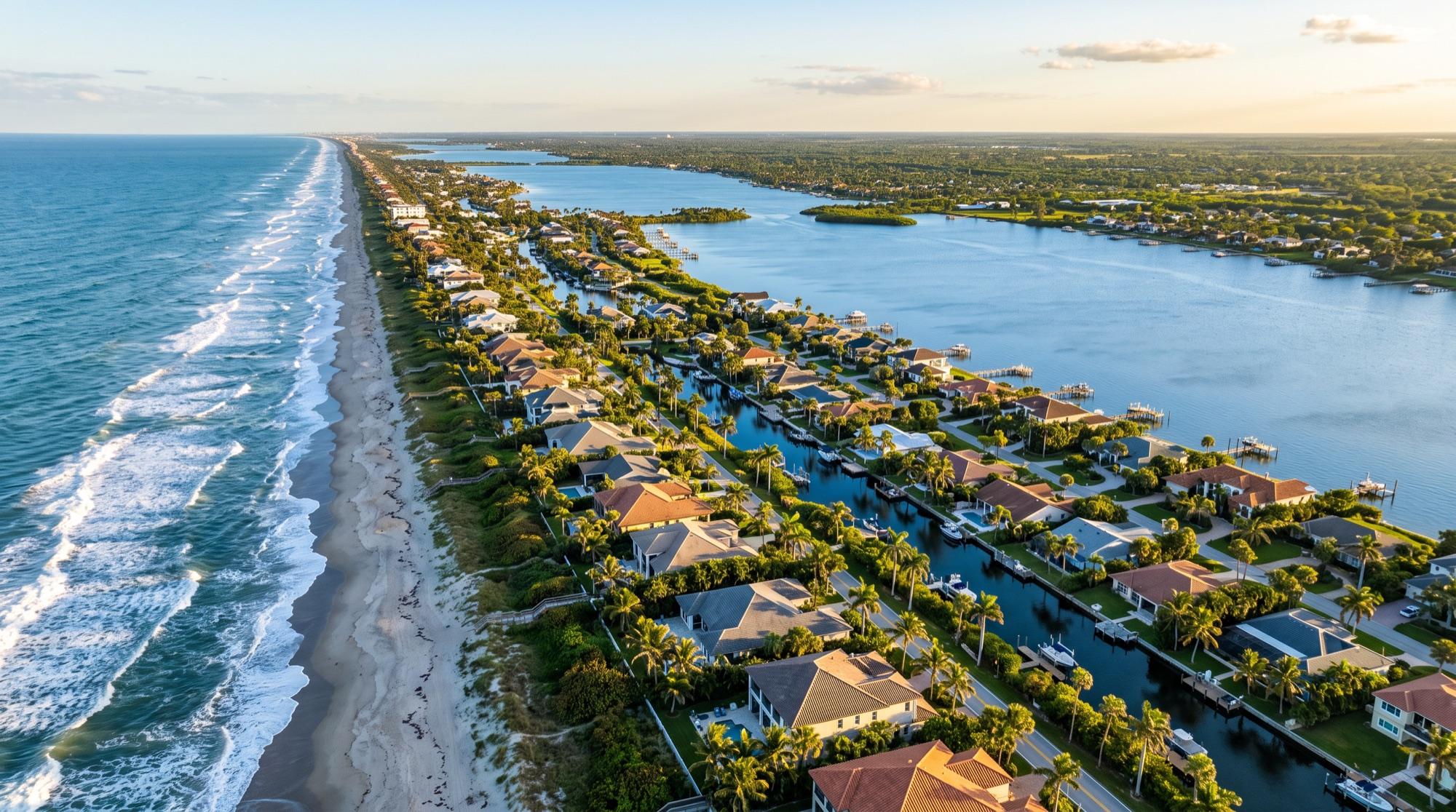
The honest version of that answer is that the range is the answer. Two houses on the same street can be quoted thousands of dollars apart based on roof age, elevation, and construction alone. And on the Space Coast, a barrier-island address and a mainland address twelve minutes apart are not remotely the same risk to an underwriter.
There is also a structural surprise waiting for most out-of-state buyers: wind and flood are two separate policies, and your standard homeowners policy covers neither flooding nor, in some coastal cases, windstorm. Budgeting one number for "insurance" is how people end up $200 a month off on their real payment.
Why the "average Florida premium" number is useless
Search for the average cost of homeowners insurance in Florida and you will get figures ranging from about $3,240 to $10,384 a year depending on which source you land on. None of them are lying. They are measuring different things:
- Some average the entire state, which drags the number up with South Florida and the Keys.
- Some quote $150,000 of dwelling coverage; others quote $450,000.
- Some include flood and windstorm; most do not.
- Some report Citizens rates, others report the private market.
Industry figures put Brevard County — the Space Coast — around $4,280 a year on average, with $3,000 to $5,000 typical for $300,000 in dwelling coverage. That is meaningfully below the statewide coastal picture and well below Southeast Florida. It is still roughly double the national average.
The useful move is not to hunt for a better average. It is to understand the six levers that decide where your address lands in that range.
The six things that actually set your premium
1. The roof — age, shape, and how it is attached
This is the single biggest lever, and it is not close. Carriers care about the roof's age, its covering, its shape, and how well it is fastened to the walls. A hip roof — sloped on all four sides — sheds wind better than a gable and earns a real discount. A roof installed to the 2001 Florida Building Code or later is treated very differently from one that predates it.
Practically: on many carriers, a shingle roof past roughly 15 years is hard to place at all, and past 20 you are often looking at a replacement condition before closing or a trip to a surplus carrier. Ask the roof's age before you ask anything else about insurance.
2. Wind mitigation features
Florida law requires insurers to discount the windstorm portion of your premium for documented wind-resistant construction. The features that move the needle are specific: hurricane clips or straps tying the roof to the walls, a sealed roof deck or peel-and-stick secondary water barrier, ring-shank nailing, impact-rated windows and doors, and that hip roof shape. More on how to claim these below — most buyers leave money here.
3. Elevation and flood exposure
Since FEMA phased in Risk Rating 2.0 starting in 2021, flood premiums are no longer set by your flood zone letter. They are calculated from the specific property: first-floor height, foundation type, distance to water, flood frequency, and rebuild cost. Two homes in the same VE zone can be quoted thousands apart. An elevation certificate is the document that settles it — get one.
4. Construction type and year built
Concrete block beats frame in a wind state. Post-2002 construction beats pre-1994 by a wide margin because of what changed in the building code after Hurricane Andrew. Year built is a proxy underwriters lean on heavily when they cannot inspect everything.
5. Distance to the coast
Underwriters draw wind zones by distance to open water, and the lines are tighter than most buyers expect — sometimes a few hundred feet matters. This is why the beachside towns below carry a different premium profile than mainland towns a short drive west.
6. Claims history — the property's, not just yours
Prior claims follow the address through the CLUE report, not just the owner. A house with two water-damage claims in the last five years is a harder risk regardless of who filed them. Ask the seller for the CLUE report during your inspection period.
Wind and flood are two different policies
This trips up nearly every out-of-state buyer, so it is worth stating plainly:
| Coverage | What it pays for | How you get it |
|---|---|---|
| Homeowners (HO-3) | Fire, theft, liability, and usually wind — but check | Private carrier or Citizens |
| Windstorm | Hurricane and wind damage, when excluded from the HO-3 | Sometimes a separate policy near the coast |
| Flood | Rising water, storm surge, lagoon and river overflow | NFIP or a private flood carrier |
Two things follow from that table. First, flood is never included in a standard homeowners policy — if you want it, you buy it separately. Second, roughly a quarter of all NFIP flood claims come from properties outside mapped high-risk zones, which is the entire argument for carrying cheap optional flood coverage when you are not required to.
Worth knowing: private flood carriers now compete hard against the NFIP in Florida and frequently come in below it. Quote both. If you want the full picture on zones and what they change, read our VE flood zone guide.
Space Coast insurance exposure, town by town
Here is the part the national calculators cannot give you. Below is how our service areas actually stack up on wind and flood exposure — the two things driving the spread in your quote — alongside what homes typically cost there.
| Town | Wind/flood exposure | Share in a flood zone | Typical home price |
|---|---|---|---|
| Melbourne Beach & South Beaches | Highest (barrier island) | ~75% | ≈ $600K |
| Cocoa Beach | Highest (barrier island) | ~70% | ≈ $450K |
| Cape Canaveral | Highest (barrier island) | ~65% | ≈ $390K |
| Indialantic | Highest (barrier island) | ~60% | ≈ $650K |
| Satellite Beach | Highest (barrier island) | ~55% | ≈ $500K |
| Indian Harbour Beach | Highest (barrier island) | ~55% | ≈ $550K |
| Merritt Island | High (island, two rivers) | ~60% | ≈ $420K |
| Cocoa & Cocoa Village | Moderate | ~25% | ≈ $280K |
| Melbourne | Moderate | ~20% | ≈ $350K |
| Suntree | Lower (inland) | ~10% | ≈ $470K |
| Rockledge & Viera | Lower (inland) | ~10% | ≈ $400K |
| Palm Bay | Lower (inland) | ~10% | ≈ $320K |
| Titusville | Lower (inland) | ~15% | ≈ $300K |
| Port St. John | Lower (inland) | ~15% | ≈ $320K |
Our Central Florida markets — Orlando, Sanford, Kissimmee & St. Cloud, and Lake County — sit lower still on wind exposure, which is exactly why some buyers priced out of a beachside premium end up looking inland.
Here is the counterintuitive part, and it is the same finding as our flood-zone analysis: the most exposed towns on this coast are also the most expensive. The beachside communities carry a median sale price roughly 40% above the mainland towns with the least flood exposure. The market is not mispricing risk. It is pricing the ocean, and the ocean is why people move here.
Wind mitigation: the discount Florida law requires your insurer to give you
Under Florida Statute 627.0629, carriers must reduce the windstorm portion of your premium when a licensed inspector documents qualifying wind-resistant features. This is not a courtesy discount you negotiate. It is a mandated credit — and it is routinely the difference between an alarming quote and a workable one.
The mechanism is a Uniform Mitigation Verification Inspection, form OIR-B1-1802. Three things to know:
- The form changed on April 1, 2026 — its first major overhaul in more than a decade, with stricter documentation requirements for impact windows, roof coverings, and roof-to-wall connections. If you are handed an older inspection, confirm it still applies.
- Inspections are valid for five years. After that your carrier is no longer obligated to honor the credits, and you need a new one. Sellers often have a current inspection sitting in a drawer — ask for it.
- The state may pay for it. My Safe Florida Home provides free wind-mitigation inspections and, for qualifying homeowners, grants toward hardening improvements. The program has been refunded for 2026.
If you buy a home on this coast and never order a wind mitigation inspection, you are almost certainly overpaying.
Is Florida insurance actually getting cheaper in 2026?
For the first time in roughly a decade, the direction has changed. Following the 2022–2023 tort reforms that cut lawsuit-driven claims, 18 new private insurers have entered or re-entered the Florida market, and carriers are filing rate decreases rather than increases:
- Citizens Property Insurance filed for an average statewide decrease of about 2.6% for 2026, with roughly 60% of policyholders seeing an average cut near 11.5%, subject to state approval.
- State Farm filed for a 10% statewide reduction.
- Florida Peninsula proposed an average 8.4% decrease.
- Patriot Select filed for 11.3%.
Read that with the right framing. These are meaningful decreases from a very high base, and they are filings, not guarantees — the Office of Insurance Regulation has to approve them. Florida remains among the most expensive states in the country to insure a home. But "rates are still climbing forever" stopped being an accurate description of this market, and buyers who wrote Florida off two years ago on that basis are working from stale information.
What to do before you write an offer
A short, specific checklist. In this order:
- Ask the roof's age and covering before you tour twice. It gates everything else.
- Get a real quote on the actual address — not a calculator estimate — during your inspection period. A good local agent turns this around in a day.
- Request the seller's wind mitigation inspection and elevation certificate. If they exist, they are worth real money. If they do not, order them.
- Ask for the CLUE report to see the property's claims history.
- Quote flood separately, NFIP and private, even if you are in an X zone.
- Put the real premium into your payment math before you decide what you can afford — our mortgage calculator has a field for it, and it changes qualifying more than most buyers expect.
Do this before the offer, not after. An insurance number that arrives three days before closing is a number you have no leverage over.
Frequently asked questions about Florida homeowners insurance
How much is homeowners insurance in Florida per month?
For a typical Brevard County single-family home, budget roughly $250 to $460 a month, or about $3,000 to $5,500 a year. Beachside homes, older roofs, and homes needing separate windstorm or flood coverage run higher; newer inland construction with strong wind mitigation credits runs lower. Statewide averages vary from about $3,240 to $10,384 depending on the source and the coverage assumed, which is why an address-specific quote matters more than any average.
Why is homeowners insurance so expensive in Florida?
Three reasons stack up: hurricane exposure concentrated along 1,350 miles of coastline, a decade of litigation-driven claims costs that drove carriers out of the state, and rising reinsurance prices. The 2022–2023 tort reforms addressed the litigation piece, which is why new carriers have returned and 2026 rate filings are trending down. The hurricane exposure is permanent, so Florida will stay above the national average regardless.
Is homeowners insurance cheaper inland in Brevard County?
Generally yes. Underwriters price by distance to open water, so mainland towns like Palm Bay, Rockledge, Viera, Titusville, and Suntree typically quote below barrier-island towns like Cocoa Beach, Satellite Beach, and Indialantic. Flood exposure follows the same pattern — roughly 10–15% of mainland parcels sit in a flood zone versus 55–75% beachside. The trade-off is that you are further from the beach, which is also why beachside homes cost about 40% more.
Does homeowners insurance cover flood damage in Florida?
No. Standard homeowners policies exclude flood entirely — rising water, storm surge, and river or lagoon overflow all require a separate flood policy through the NFIP or a private carrier. This is the most common and most expensive misunderstanding out-of-state buyers bring with them. Note also that about a quarter of NFIP claims come from outside high-risk zones, so "I'm in an X zone" is not a reason to skip it.
Can I get homeowners insurance on a home with an old roof in Florida?
It gets difficult past about 15 years for shingle and harder past 20. Options narrow to surplus-lines carriers at higher cost, or the roof gets replaced as a condition of closing — frequently negotiated as a seller credit or a price adjustment. Always confirm the roof's age and get an insurance quote during your inspection period, because discovering this at closing gives you no room to negotiate.
Are Florida homeowners insurance rates going down in 2026?
For many policyholders, yes — the first real reversal in about a decade. Citizens filed for an average 2.6% statewide decrease with roughly 60% of customers seeing cuts near 11.5%; State Farm filed for 10%, Florida Peninsula 8.4%, and Patriot Select 11.3%. Eighteen new private insurers have entered the market since the 2022 reforms. These are filings pending regulatory approval, and they are decreases from a historically high base, so Florida remains expensive in absolute terms.
Do I need flood insurance if I'm not in a flood zone?
You are not required to, but it is usually worth buying. Outside high-risk zones, premiums are low, and roughly a quarter of all NFIP claims come from exactly those areas. Under Risk Rating 2.0, your premium reflects your specific property rather than the zone line, so the only way to know what it costs is to get the quote.
What is a wind mitigation inspection and do I need one?
It is a licensed inspection documenting wind-resistant features — roof shape, roof-to-wall attachment, roof deck sealing, impact-rated openings — recorded on state form OIR-B1-1802. Florida Statute 627.0629 requires insurers to apply premium credits for verified features, so the inspection frequently pays for itself many times over in the first year. It is valid for five years, and the form was updated on April 1, 2026.
Get a real number on a real address
Insurance is the most common reason a Florida purchase falls apart late, and it is almost always avoidable. We quote wind and flood side by side, pull the flood determination and elevation certificate, ask the seller for the wind mitigation inspection and CLUE report, and put the actual premium into your payment math before you write the offer.
Start with our insurance resource guide for coverage types end to end, or the flood zones guide for zone-specific process. Compare exposure town by town on the service area map, or look at the two ends of the trade-off directly: Cocoa Beach on the barrier island against Rockledge & Viera inland. Running numbers? Try the mortgage calculator and our closing costs breakdown. Browsing? See current Space Coast listings.
When you have an address in mind, get in touch and we will run the real numbers on it.
Premium figures are industry-reported ranges and averages, not quotes — your actual premium depends on the specific property, carrier, and coverage selected. Rate filings cited are pending or recently approved Florida Office of Insurance Regulation filings and are subject to change. Flood-zone share figures are 7 Waves estimates of the approximate share of parcels within a FEMA flood zone and are not a substitute for an official FEMA determination. Typical home prices are approximate market medians. Nothing here is insurance, legal, or tax advice — consult a licensed Florida insurance agent for coverage decisions. Information deemed reliable but not guaranteed.
Want to talk this through?
Ask a local agent — no obligation, and usually an answer the same day.