


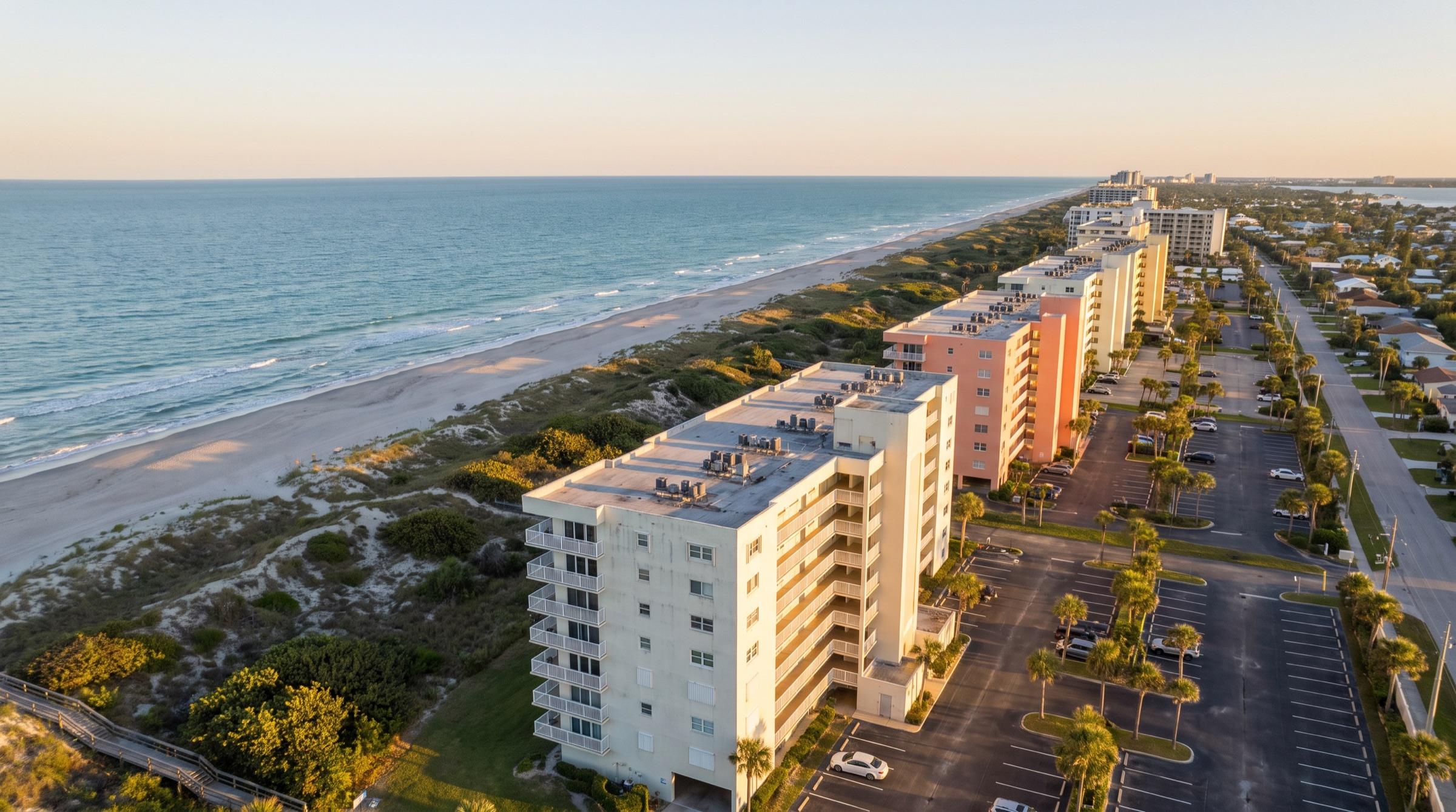
Milestone inspections and structural integrity reserve studies now decide whether a Florida condo is a good buy. What the law actually requires in 2026, why special assessments are landing now, what you are legally entitled to see before closing — and why three-quarters of Cocoa Beach's listed condo inventory sits in buildings already past 30 years old.
The short answer
Since the Surfside collapse, Florida has required older condo buildings to prove they are structurally sound and to fund the repairs that proof turns up. Two documents now decide whether a condo is a good buy: the milestone inspection report and the structural integrity reserve study (SIRS). Between them they explain nearly every special assessment and dues increase on this coast.
The rules, in one paragraph: buildings three habitable stories or taller must have a milestone structural inspection by December 31 of the year they turn 30, then every 10 years — and a local building official may require it at 25 years where salt-water exposure warrants it. Separately, those same buildings must complete a SIRS covering eight structural components, and associations may no longer waive or underfund reserves for them, no matter how the owners vote.
Why this matters more here than almost anywhere: 82% of active residential listings in Cocoa Beach and 83% in Cape Canaveral carry association dues, and the median Cocoa Beach building in that inventory was built in 1981. Roughly three-quarters of it is already past the 30-year mark. This is a condo coast, and it is an old condo coast.
None of that is a reason to avoid condos here. It is a reason to buy the building, not just the unit — and after four years of compliance work, the buildings that have done it are now identifiable in a way they never were before.
What a milestone inspection actually is
Florida Statute 553.899 applies to any building three habitable stories or more in height under condominium or cooperative ownership. ("Habitable" matters — a 2025 clarification means floors used only for parking, storage, or mechanical equipment don't count toward the three.)
It runs in two phases:
Phase one is a visual examination of habitable and non-habitable areas by a licensed architect or engineer, due within 180 days of the building owner receiving written notice from the local enforcement agency. If the inspector finds no substantial structural deterioration, that is the end of it.
Phase two is triggered only if phase one identifies substantial structural deterioration. It can involve destructive or non-destructive testing, and a progress report is due within 180 days of the phase one report. Where repairs are required, work must begin within 365 days of receiving the phase two report.
Two more provisions buyers should know:
- The inspector submits a sealed report and a plain-language summary to both the association and the local building official. The association must distribute that summary to every unit owner within 45 days, by mail and electronically.
- The association pays for the inspection on everything it is responsible for maintaining — which, in a condo, is the structure. That cost lands in the budget, which lands in your dues.
The 30-year vs. 25-year question — get this right
You will read all over the internet that coastal Florida buildings are inspected at 25 years. That was closer to the original 2022 law. The statute today sets 30 years as the statewide trigger, and then allows the local enforcement agency to determine that local circumstances — "including environmental conditions such as proximity to salt water" — warrant 25 instead.
In practice that means the answer for a specific Cocoa Beach or Cape Canaveral building comes from the city or county building official, not from a blog post. Local officials can also extend an initial deadline for good cause. Ask the association for its written notice and its current status; if there isn't one, call the building department. That single phone call resolves more uncertainty than any amount of reading.
The SIRS: where the money comes from
The milestone inspection tells you what is wrong. The structural integrity reserve study decides who pays for it and when — and it is the reason dues have moved so sharply on this coast.
A SIRS is a reserve study covering eight components: roof, load-bearing structure, fire protection, plumbing, electrical, waterproofing and exterior painting, windows and exterior doors, and any other item whose deferred maintenance or replacement cost exceeds a statutory threshold and whose failure would compromise the other seven. HB 913 raised that threshold from $10,000 to $25,000, indexed for inflation — DBPR set the 2026 figure at $25,675.
The rule that changed everything: for those eight components, reserves can no longer be waived or reduced by owner vote. For decades, Florida associations kept dues low by voting reserves down every year and dealing with the roof when the roof failed. That option is gone for structural items. Buildings that deferred for thirty years are now funding thirty years of deferral on a compressed schedule.
HB 913, effective July 1, 2025, added some relief valves rather than reversing the mandate:
- An association that has completed its milestone inspection may pause or reduce reserve contributions for up to two consecutive budget years to fund the repairs that inspection identified.
- Associations may use loans or lines of credit to fund reserves rather than assessing everything up front.
- Deadlines were extended and conflict-of-interest and DBPR reporting rules were tightened.
For a buyer, that flexibility cuts both ways. A building that paused reserves to do real repairs is doing exactly what the law intends. A building that paused reserves and did nothing has simply moved the problem into your ownership.
Why this shows up as a special assessment
A special assessment is what happens when the reserve balance doesn't cover the repair the milestone inspection found. On an older beachside building, the common ones are concrete restoration and balcony repair, roof replacement, window and door replacement to current code, waterproofing and painting, and elevator modernization. They are frequently six figures per building and five figures per unit.
Three things determine whether that lands on you:
- Has the assessment been levied? If the board has voted it, it is disclosed and negotiable — sellers routinely pay it at closing.
- Has it been discussed? Board minutes are where an assessment lives for the six months before it is levied. This is the single most-skipped document in condo due diligence.
- Is the reserve schedule adequate? A fully funded SIRS schedule means the next repair is already paid for. An underfunded one means the assessment simply hasn't been named yet.
What this looks like on the Space Coast, in real numbers
From our Space Coast MLS feed, across active residential listings, with dues normalized to a monthly equivalent:
| Town | Listings with dues | Median dues/month | Median year built | Share built 1996 or earlier |
|---|---|---|---|---|
| Cocoa Beach | 200 | $858 | 1981 | 74% |
| Indialantic | 89 | $653 | 1995 | 53% |
| Cape Canaveral | 123 | $625 | 1985 | 66% |
| Satellite Beach | 127 | $620 | 2014 | 33% |
| Indian Harbour Beach | 48 | $500 | 1984 | 75% |
| Melbourne Beach | 107 | $385 | 1994 | 52% |
| Merritt Island | 124 | $118 | 2000 | 44% |
Read the Cocoa Beach row carefully. A median build year of 1981 means the typical fee-carrying listing in town sits in a building that turned 30 in 2011 — well inside the compliance window, and in many cases already through its first inspection cycle. That is not a warning. It is an advantage, because those buildings have now been examined by an engineer and have a reserve schedule on paper. The unknown-condition era is over on this coast; you can find out.
Satellite Beach is the useful contrast: a median build year of 2014 and only a third of inventory past 30 years. Newer stock, lower structural risk, higher entry price. Both are legitimate buys. They are different buys.
Statewide context matters too. Florida condo inventory has ballooned — condos and townhomes are running well past a year of supply, squarely a buyer's market — precisely because assessment fear has thinned the buyer pool. Buyers who can read a reserve study are shopping with very little competition right now.
What you are legally entitled to receive
This is the part most buyers never exercise. Under Florida's condominium resale disclosure law, a seller must provide you with the association's governing documents and financials, plus:
- the inspector-prepared summary of the milestone inspection report, if one applies;
- the turnover inspection report for inspections performed on or after July 1, 2023;
- the association's most recent SIRS — or a written statement that the association has not completed one.
And the teeth: the purchase agreement is voidable by the buyer on written notice within three days (excluding Saturdays, Sundays, and legal holidays) of the later of contract execution and your receipt of those documents. Any purported waiver of that right is of no effect.
"The association has not completed a SIRS" is itself an answer — and on a 1970s oceanfront building in 2026, it is a loud one.
The financing angle nobody mentions until it's too late
Even a building you are comfortable with can fail your lender's test. Fannie Mae and Freddie Mac maintain lists of condo projects ineligible for conventional financing over inadequate reserves, structural deficiencies, deferred maintenance, delinquencies, or insurance gaps. A project on that list is cash-buyers-only in practice, which cuts its resale pool and its price.
The rules tightened again in 2026, per coordinated policy updates the agencies announced in March:
- Limited and streamlined review pathways retire for loan applications dated on or after August 3, 2026 — projects with 11 or more units face full review regardless of down payment.
- Master policy per-unit deductibles cap at $50,000 effective July 1, 2026.
- The reserve requirement rises from 10% to 15% of annual budgeted income for applications dated on or after January 4, 2027.
Practical consequence: verify project eligibility with your lender early, before inspection money is spent. A building can be structurally fine and still be unfinanceable this quarter.
The buyer's checklist
In order, during your inspection period:
- Milestone inspection status — completed, due, or extended? Get the phase one report, any phase two report, and the owner summary. If the building is 3+ stories and 25 or more years old, confirm the trigger age with the city or county building official.
- The SIRS — or written confirmation there isn't one. Read the funding schedule, not just the cover page.
- Two years of board minutes. Assessments are debated here long before they are levied.
- The current budget and reserve balance, plus whether reserves are being funded, paused under the HB 913 provision, or borrowed against.
- Any levied or pending special assessment, in writing, with the payoff amount and whether the seller will satisfy it at closing.
- The master insurance policy — coverage, wind and flood, and the per-unit deductible. Then quote your own HO-6.
- Lender project eligibility, confirmed before you spend on inspections.
- Rental restrictions and delinquency rate. High delinquencies predict future assessments and can independently kill financing.
The reframe
Four years of compliance work has sorted Florida's condo stock into buildings that did the work and buildings that didn't — and for the first time, the paperwork tells you which is which. A building with a clean milestone report, a funded SIRS, and a board that assessed early is a better buy than it was in 2020, because the biggest unknown in condo ownership has been converted into a document you can read.
The mistake is not buying a Florida condo. The mistake is buying the unit and skipping the building.
Frequently asked questions about Florida condo milestone inspections and assessments
What is a milestone inspection in Florida?
It is a structural inspection required by Florida Statute 553.899 for condominium and cooperative buildings three or more habitable stories tall. Phase one is a visual examination by a licensed architect or engineer, due within 180 days of the association receiving written notice; phase two, involving testing, is required only if phase one finds substantial structural deterioration. Reports go to the association and the local building official, and the association must distribute a plain-language summary to every unit owner within 45 days.
At what age does a Florida condo need a milestone inspection — 25 or 30 years?
Thirty years is the statewide trigger, with inspections every 10 years thereafter. The local enforcement agency may determine that local circumstances — including environmental conditions such as proximity to salt water — require the first inspection at 25 years instead, and may extend an initial deadline for good cause. Because it is a local determination, confirm the trigger age for a specific building with the city or county building official rather than assuming.
What is a structural integrity reserve study (SIRS)?
A reserve study covering eight structural components — roof, load-bearing structure, fire protection, plumbing, electrical, waterproofing and exterior painting, windows and exterior doors, and any other item above the statutory cost threshold whose failure would affect those systems. The threshold rose from $10,000 to $25,000 under HB 913 and is inflation-indexed, set at $25,675 for 2026. Associations may not waive or reduce reserve funding for those eight components regardless of an owner vote.
Do Florida condo buyers get to see the milestone inspection and SIRS before closing?
Yes. Sellers of resale condominium units must provide the association's governing documents and financials, the inspector-prepared summary of the milestone inspection report if applicable, the turnover inspection report for inspections on or after July 1, 2023, and the most recent SIRS — or a written statement that no SIRS has been completed. The contract is voidable on written notice within three days, excluding weekends and legal holidays, after you receive them, and that right cannot be waived.
Why are Florida condo special assessments so common right now?
Because two things happened at once: milestone inspections started identifying deferred structural repairs, and the law simultaneously stopped associations from waiving reserves on structural components. Buildings that kept dues low for decades by voting reserves down are now funding decades of deferred maintenance on a compressed schedule. On the Space Coast, where the median fee-carrying Cocoa Beach listing sits in a building constructed around 1981, most of the inventory is inside that window.
Should I avoid buying an older Florida condo?
Not on age alone. A 1980s building with a completed milestone inspection, a funded SIRS, and an assessment already levied and paid is often a safer purchase than a building with no inspection on file, because the structural condition is documented rather than assumed. The risk is not the building's age — it is buying without reading the reports, the reserve schedule, and two years of board minutes.
Can I get a mortgage on a Florida condo with a special assessment?
Often yes, but it depends on the project and the lender. Fannie Mae and Freddie Mac maintain lists of condo projects ineligible for conventional financing over inadequate reserves, structural deficiencies, significant deferred maintenance, high delinquencies, or insurance shortfalls, and both tightened standards in 2026 — limited and streamlined reviews retire for applications dated on or after August 3, 2026, per-unit master policy deductibles cap at $50,000 from July 1, 2026, and the reserve requirement rises to 15% of annual budgeted income for applications dated on or after January 4, 2027. Confirm project eligibility with your lender before spending money on inspections.
How much are condo fees in Cocoa Beach and Cape Canaveral?
In our current MLS data, normalized to a monthly equivalent, the median association fee is about $858 in Cocoa Beach and $625 in Cape Canaveral, against roughly $225 across Brevard County as a whole and $91 in Palm Bay. Beachside dues are high largely because the association buys the building's wind and flood insurance and spreads it across the units — and increasingly because reserve funding for structural components is now mandatory. Compare carefully when you shop: Florida listings quote dues monthly, quarterly, semi-annually, or annually, so two buildings can look far apart on paper and be within a few dollars a month of each other.
Buy the building, not just the unit
Reading a condo package properly takes a few hours and saves five-figure surprises. We pull the milestone reports, the SIRS and its funding schedule, two years of minutes, the budget, the master policy and its deductible, and the delinquency rate — then we tell you what the dues are likely to do over the next five years, not just what they are today.
Start with our condos and townhomes specialty page for how we vet buildings, or what Florida homeowners insurance actually costs for the wind-and-flood exposure driving your dues. See what the trade-off looks like town by town in Cocoa Beach and Cape Canaveral, or read the wider budget picture in what it actually costs to live in Florida. Browsing? See current Space Coast listings.
When you find a building you like, get in touch — send us the address and we will read its paperwork before you write an offer.
Association-dues figures are normalized to a monthly equivalent from the frequency each listing reports (monthly, quarterly, semi-annual, or annual) and exclude voluntary and one-time fees. This article summarizes Florida law as of July 2026 and is not legal advice. Milestone inspection trigger ages, deadlines, and extensions are determined in part by local enforcement agencies and vary by jurisdiction — confirm with the building official having jurisdiction over a specific property. Statutory thresholds are inflation-indexed and change annually. Association-fee, build-year, and listing statistics are 7 Waves calculations from active Space Coast MLS residential listings as of July 2026 and describe listed inventory, not all housing stock. Lending guidelines are those published by Fannie Mae and Freddie Mac and are subject to change — verify with your lender. Consult a Florida community association attorney for guidance on a specific building. Information deemed reliable but not guaranteed.
Want to talk this through?
Ask a local agent — no obligation, and usually an answer the same day.